Archive | For Filmmakers

T. R. Locke’s 2nd Edition Hits #1 Hot New Releases

Posted on 02 April 2013 by T.R. Locke

#1 Hot New Release in Music BusinessBurbank–April 2, 2013–Since yesterday was April Fool’s Day, I decided to hold off on this post until today lest anyone think I was joking when I posted on Facebook yesterday that the 2nd edition of my book, “What I Wish I Knew Before I Moved to Hollywood” hit #1 in Hot New Releases in the Kindle store for books on the Music Business.  It is currently ranked the #6 bestseller overall in that category, climbing up from #14 last week in that same category.  For all music business books, print and electronic, it leaped 40 spots to #32 this week, from #72 last week.

The book also rose in the kindle category of Bestselling Humor and Entertainment–Movies and Video from the 90s to a solid #46–ahead of “Save the Cat Goes to the Movies” and “Script Lab’s Encyclopedia of Screenwriting.”

The strength of the book sales is buoyed by positive word of mouth and numerous 5 star reviews on Amazon and across the web. Often a book premiers and takes off within a week of release only to see sales slack off. But What I Wish I Knew Before I Moved to Hollywood is steadily moving up the charts as more and more people talk about it and Amazon consistently features it because of its strong sales.  Moved up to #6

The radio interview I conducted with host Bill Thompson of The Bookcast last week, where he referred to me as “a wise Buddha” no doubt helped fuel the boost as well. The  interview is available here.  Although mostly focused on the struggle of artist dreaming of Hollywood, the interview was able to touch on the concept that achieving all dreams requires a certain singularity of focus that encounters significant resistance no matter where those dreams lead. The skill set an artist needs to overcome a negative critique or poor record sales or failed audition is similar to the skill set needed for a businessperson to overcome a failed product launch, or a difficult market. The same mental power needed to push past the negative self-talk and self-destructive behaviors that often plague artists, is needed to overcome everyday obstacles as well.  The book is invaluable for anyone looking to be an actor, singer, rapper, director or producer, but it is still very powerful for people seeking hope that dreams can and do come true.

I’m a bestselling author now. I’m living proof of the concepts that I share in the book. But don’t take it from me–take it from the Emmy and Grammy-winning artists, the platinum selling producers and TV Stars I interview who share their 100+ years of combined experiences.

On June 1, 2013,  I will be speaking at the Organization of Black Screenwriter’s (OBS) Monthly meeting. Various topics are being considered for that meeting including: “Protecting your Artistic Soul–How to Keep Hollywood from Killing your Dream,” “Novelizing Your Screenplays–Stop Waiting for Hollywood to Validate (or pay) You,” and various other topics related to issues  covered in the book. (More details to follow.)  Stop Waiting for Hollywood to Validate You is a comment from an #46 in Kindle --Humor and Entertainment- Movies and VideoEmmy-Winning producer I interviewed in the book.  The phase is indicative of a mindset that plagues so many artists. Artists often believe they are talented, but act as if they are helpless until someone bestows validation on them–a contest win, a contract, an agency agreement, a million-dollar paycheck–or even an unpaid internship. It’s a mindset that begs to be disrespected.

I hope to help fuel a new movement (or at start a conversation about a new movement)  in Hollywood. There are so many amazing stories out there that are sitting around waiting for some Hollywood producer or actor to shepherd them to the big screen.  But what makes it to big screen is completely controlled by mass appeal. Or better yet, by what someone believes will have mass appeal. Even better–what someone thinks has mass appeal… AND LOTS OF LUCK. I want to see writers taking control of their own destinies. Writers are the creators, and the Hollywood dragon lives on our blood. Without writers Hollywood dies. The only reason Hollywood doesn’t respect writers more is because writers don’t respect themselves more.

Writers, actors and other artists have more opportunity today than ever to reach their audience and to make a living as the professional they dream of being. What I Wish I Knew Before I Moved to Hollywood is a guide for helping artists take control of their power, hold it, and wield it to their benefit. It is priceless reading for those who’ve not yet arrived in Hollywood, but it has immense relevance to those here working day-by-day as well. Give your friends and family members the gift of encouragement and the key to following dreams with their eyes wide open. Check out the book today.

Comments (1)

Tags: , , , , , , , , ,

New E-Book Releases–Goodreads Giveaway for Paperback Launches

Posted on 14 March 2013 by T.R. Locke

Kindle Book ImageEvery year 111,000 people move to L. A.–many of them looking for success in the entertainment industry. Tens of thousands audition for American Idol, America’s Got Talent, X-Factor and other talent shows hoping to break into an industry most only think they know. My goal is to help them know it better so that they have a better shot at their dreams.

On March 7th, I released the 2nd edition of What I Wish I Knew Before I Moved to Hollywood exclusively on Kindle. The new edition contains new interviews with an Emmy-winning producer and Film-festival winning screenwriter/director along with the interviews with Grammy-nominated singers, platinum-selling producers and award-winning movie and TV stars. The new edition is available for only $4.99, which is about a 1/3 the paperback price.

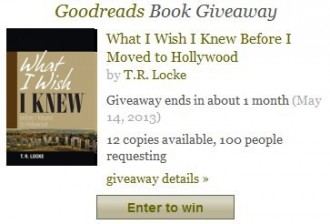
To help spur interest in the new edition’s release, I’m giving away 12 autographed copies of the 1st edition paperback in a contest on Goodreads (Click here to enter).  The contest runs through May.

If you know or care about anyone even thinking about a career in the entertainment business, no matter where they are in the process, get them this book. The title is What I Wish I Knew BEFORE I Moved to Hollywood, but the information is good for people already in Hollywood, too. What does it take to keep going?  How do you get seen? How do you get booked? How do you stand out?  What is your voice? Your niche? Your type?  And how do you stay encouraged in the hard times? Every year 111,000 move to L. A.  But every year 100,000 move away–many dejected, frustrated and sad. Those are the ones who didn’t read this book.

What’s it take to make it as a singer in Hollywood–read what Chante Moore had to say about it in my book. Trying to be comedian? Read what a standup comedian and writer for Steve Harvey, D.L. Hughley and Bernie Mac says. Want to be a producer? See what the Emmy-winning producer has to say. Want a directing/screenwriting/development deal at HBO? My interviewee had one.  Want to be an actor? Find out what a star who makes $250,000 a week says about how to become one. Want to do make-up? Find out what the head make-up artist for one of Fox’s hit dramas says you should do. Want to rap or make beats? Find out what Dr. Dre and Ice Cube’s go to guy says.

Artists love to act like they have it all together–keep a smile, be positive, stay away from negative energy. That’s all great. But are you getting where you want to go? If not, it smart to get help when you need it. It’s one thing to make others think you have it all together; it’s quite another to fool yourself.

Comments (1)

Magical White People—Hollywood’s Newest Stereotype

Posted on 18 March 2012 by T.R. Locke


Why aren’t white people up in arms marching against filmmakers for Hollywood’s ceaseless portrayal of them as being magical? It must really be sad to be constantly portrayed as such amazing beings when real life is so mundane and nondescript.  But Hollywood appears to be in love and when Hollywood is in love, there is no stopping them.

I don’t believe a script can be greenlit in Hollywood today unless it has some magical white man with a sword, superpower, or ability to jump high or fly. It’s like every white guy all of a sudden is Chase Budinger from the Houston Rockets. (Chase on Video.)

But what’s more amazing is that, except for Storm in X-men, these superpowers are held exclusively for white people. No Latins, no Asians, no Blacks…no, no, no. Not even the original magical flying people—Arabs. What’s with the non-inclusion? Isn’t Hollywood the bastion of liberalism? Is there no room at the studios for the rest of the world to be magical, too? Don’t you think everyone would like to fly, Hollywood? Let them all in on the action.  Yes, I know that the Avengers is coming out, but that’s just one black guy—who used to be Italian by the way—and who’s played by the same guy who played the last magical black guy in Star Wars. Asians, Arabs and Latinos want in on this, too—let alone other black actors. Not spreading the super around puts too much pressure on white people to be amazing.

Add to all the magic the historical redos that turn the Dark Age days of plague into a rockin’ great time in history. Henry the 8th looks nothing like the corpulent, dough-faced, glutton I studied as a teen—let alone that all of his self-portraits display—and his descendants evidence in their utter homeliness. Today he’s a chiseled, handsome, young playboy who spends more time in the gym than the vomitorium. From Game of Thrones to Spartacus to Abraham Lincoln vampire hunter, no more do the rotten, infected, wooden teeth of George Washington and the putrid stench of Victorian women pose an obstacle to romance—let alone superpowers. In fact, nothing seems more attractive in modern movies than a woman awash in whale blubber perfume and lacking deodorant.

I’ve taken to calling all such movies, “Magical White People (MWP)” movies—and I’ve created a sub-class “with Swords (MWP-s)”—just to keep track of them because they are a-plenty. Is there a white teen anywhere that can’t move cars with his mind, fly through the air, read someone’s mind, and cast a spell? Is there a white guy over 20 who can’t kill a murderous dragon with his bare hands, take down an army single-handedly, hunt down and kill a pack of wolves or terrorists with a cell phone and dental floss? I don’t think so. White people in movies are amazing. And they are becoming more and more amazing with every Hollywood release.

We must address this trend in filmmaking before the inevitable occurs: White people around the world, unable to live up to the expectations of superdom, face a coming epidemic of emotional breakdowns. I say this because none of my white friends, nor those I commonly experience in my day-to-day life, possess any of the exceptional qualities today’s films bestow upon them. When I ask them to reveal their superpower, they drop their heads in abject surrender to reality—not unlike my own reaction when, after a loss, I’m asked by my white teammates why I didn’t just dunk the basketball.

The pressure Hollywood places on white people therefore dooms them to repeated disappointment when called upon by humanity. Join me in calling on Hollywood to stop these wild, stereotypical portrayals of white people. White people are just like everyone else and it’s time for Hollywood to recognize this.

(The 2nd edition of  What I Wish I Knew Before I Moved to Hollywood available now exclusively on Kindle for only $4.99. Get yours now. Click here. Kindle e-books can be read on I-phone, I-pod, I-pad, Android, Mac and PC with the free Kindle App.)

Comments (20)

Tags: , , , , ,

Why Red Tails is NOT a Black Movie

Posted on 21 January 2012 by T.R. Locke

George Lucas's Red Tails

There’s been a lot of reporting lately about the importance of George Lucas’s new movie Red Tails for the Black community. The argument goes like this: If people don’t go see Red Tails, Hollywood will never fund higher budget black movies again.  Although the basic altruism of White people might be moved by this argument, it is primarily an argument to the Black community to get behind this movie. But it is the wrong argument and not the thing Hollywood is looking for. For a movie of this budget to succeed, this movie must draw Blacks AND Whites… Latinos, Asians and every other race, too. So how does this argument work for them? It doesn’t. All people care about is whether a movie is good—does it move us, does it entertain…is it worth the price of admission? The right argument for why people should see Red Tails is because it’s a great movie that talks about an important part of American History that has been hidden from them for some reason. Why did they hide this? What happened?

Think about it this way: People went to see National Treasure and DaVinci Code because they were stories that argued that there COULD be some hidden history that was kept hidden by a secret cabal. Here is a film about something that actually IS hidden history—that actually has been KEPT HIDDEN from American citizens for some reason. The things that happened in this film are real–the real story of  real people. This isn’t some novelist’s speculating. It is reality.

Seeing as I’ve just returned from viewing the movie last night, I want to make a second argument that I think works for everyone. Red Tails is not a black movie. Red Tails is an action film by George Lucas—the best and most successful action movie producer in the history of the planet earth according to Star Wars and Indiana Jones.

And here’s a third great reason that was suggested to me by my daughter: This movie is about real heroes. It doesn’t glamorize or sugarcoat war and it doesn’t show superhumans fighting alien machines. It is real people fighting a real war—real human heroes fighting against very strong odds, with consequences dire for our real world.

Think about this: Every movie hitting the theaters today seems to paint heroes as supernaturally gifted—from vampires, wizards, witches, warlocks and werewolves worshipped by our kids to mutants and dozens of other miraculous flying, radiating, flaming, costumed millionaires. There aren’t very many films showing real young men struggling to be courageous. There aren’t many films that tell your child—be he or she black, white, yellow or brown that heroism is within them.  There are a lot of fantasy films that tell your child that there are magical people in the world who can solve all the world’s problems. But there aren’t many that tell them they have all they need inside of themselves and that courage, loyalty, tenacity, and faith are qualities God instilled in all men.  Red Tails does this.  Do you want your child believing they have to be magically bitten by radioactive bugs, exposed to chemicals, born the magical wizard, or strangely mutated to be heroic—to be the hero in their own lives or in the world?

Red Tails is a film about everyday underdogs overcoming internal, external and societal obstacles to become heroes. And that’s why everyone should see this film.

Update 3/7/2013: (The 2nd edition of  What I Wish I Knew Before I Moved to Hollywood available now exclusively on Kindle for only $4.99. Get yours now. Click here. Kindle e-books can be read on I-phone, I-pod, I-pad, Android, Mac and PC with the free Kindle App.)

Comments (8)

Tags: , ,

Filmmakers Use Free Web Software to Make National Commercial $$$

Posted on 11 March 2011 by T.R. Locke

In case you didn’t see the possibilities of the free filmmaking software from Xtranormal I wrote about in February of last year, I recently noticed a great use of it in a national commercial. A filmmaker used the software to create a simple commercial. Geico bought the commercial ($$$) and put it out nationally. Here’s a link in case you haven’t seen it. 

Comments (14)

Tags: , , , ,

Film Festivals, Yahoo Posts and Other Stuff

Posted on 11 March 2011 by T.R. Locke

Check out my first article on Yahoo’s Associated Content. Let me know what you think.

I’m going to start expanding my blog a bit to make it a more useful tool for screenwriters, actors, musicians and other folk in the biz. You should be seeing more content posted in more relevant areas soon as I work at incorporating other sources with my own writing here. I’d appreciate your feedback throughout the process so I can know how to best help my readers.

Update 3/7/2013: (The 2nd edition of  What I Wish I Knew Before I Moved to Hollywood available now exclusively on Kindle for only $4.99. Get yours now. Click here. Kindle e-books can be read on I-phone, I-pod, I-pad, Android, Mac and PC with the free Kindle App.)

Comments (9)

Tags: , , , , , , ,

New Free Movie Making Animation Software–Interesting

Posted on 16 February 2010 by T.R. Locke

Sarah Palin is a lightning rod of media attention. Her endurance in mass media has been amazing. When I came across this cool  new movie making animation software program by Xtranormal called Text to Movie and her pre-animated avatar, I couldn’t resist using her image to help push my book on Larry King.

Although this program is limited a bit by its computerized voice and actions, the possibilities of what can be done with it, even in its current state, are compelling.

I wrote this script, directed it and uploaded it in a matter of minutes. Getting the timing as right as possible and getting the voices to say what I wanted, took a couple hours, but viola. Moments after posting, it had garnered over a hundred views and hopefully will keep spreading.

This technology holds huge promise for writers and directors:  sharing story ideas, jokes, writing short scenes and even creating an entire web series. As the technology and text to speech capacity improves, I can imagine a lot from this program. Tell me what you think.

TRL

Comments (5)

Tags: , , , , ,

Staying Encouraged: “Errendipity”- A Course in “Nearacles”

Posted on 08 February 2010 by T.R. Locke

You are desperate. You have looked for a job for months and found nothing. You called all your friends and family, searched job sites, applied at the unemployment office and still…nothing. You pray. You pray hard. “God please.” The baby suddenly cries and you realize you are out of milk. At the grocery store, you run into an old friend you have not seen in years. You chat about old times and life and mention your job situation and he tells you that he recently just spoke to someone who told him of a job that is perfect for you. It is exactly what you love to do. It is in your field and you are qualified. Furthermore, it pays more than you have ever earned and has benefits twice as good as your previous job. You can hardly believe it. If the baby had not cried right then, you would have missed this connection. Wow.

You are overjoyed. You call the contact. It turns out to be a guy you know from school. You shoot the breeze and he invites you in for an interview. The interview goes swell. The second interview happens to be with a woman you met the previous year at a convention. The coincidence is mind boggling. She loves you. “You’ll be great in this position. I’ll call you in three days.”

Three days pass. Nothing. You call. They decided to eliminate the position to save money. Or worse, they decided to hire someone else. You are in the exact same situation as you were before, but now there is a tinge of pain.

“Serendipity,” noun-a chance meeting that leads to something good. “Errendipity,” noun-a chance meeting, occurrence or coincidence, thought to be something good, positive or lucky, that leads… to nothing.” Serendipity is based on an old Persian word for Sri Lanka: Sarendip. Perhaps its slight antithesis should be some unreal or imaginary place-like a mirage. Maybe the word should be “Mirageny” or “Miragenous”-when something you want appears suddenly and unexpectedly in your hand, then vanishes.

The home team is down by one point. Two seconds remain in the game. The press is on. The crowd screams. Your teammate snatches the in-bound ball and passes quickly to you at mid-court. You pivot. You jump. You shoot in milliseconds. Just before the buzzer. The ball arcs in slow-motion straight for the basket. The crowd holds its breath. It looks good. Your heart wants out of your body. The ball hits the rim. Bangs the board. Then the rim again…loops around…and around… and around…and… falls… out. Yes, out, not in. You lose! It was close though. So close. But you lose.

That situation calls for another word we need to create. It is not the same as “Errendipity” or “Mirageny.” Answers to prayers are called miracles. What is the opposite of a miracle? The definition of miracle is “a wonderful occurrence oft attributed to supernatural powers.” What would be an occurrence that appears miraculous, but turns out to be nothing? How about a “Nearacle” -almost a miracle? Or maybe “Miracal”-it looks like a miracle at first glace, but is not. Nearacles produce situations in which people sigh in disappointment. “Sighful” situations. Or maybe something like the opposite of awesome…”Naahsome.”

Life, of course, is full of such Naahsome, Errendipitous, Miragenous Nearacles. When you are trying to make it in Hollywood, exponentially so-the producer that was wild over your screenplay gets fired. The exec that green-lighted your film changes her mind. The label says you cannot do your favorite song. The star you were banking on becomes unavailable. A film similar to yours does bad boxoffice. The star who turned down the role you later booked decides she will do the part after all. Test audiences go boo-no release. Your script sticks in development. Turnaround. They do not renew the option. The suits do not like your rewrite. The label promotes another artist ahead of you again. The financing falls through. It rains in Spain on the plain and the price of rice in China goes through the roof.

The motivational speaker Les Brown says this: “A dream can be nurtured over years and years and then flourish rapidly. Be patient. It will happen for you. Sooner or later, life will get weary of beating on you and holding the door shut on you, and then it will let you in and throw you a real party.”

Les is probably right. But in the meantime, why not learn to thank God for our Nearacles and accept that they too are all part of the gift of life. They are certainly fixtures on the road to your dreams-especially if those dreams include making it in Hollywood.

Update 3/7/2013: (The 2nd edition of  What I Wish I Knew Before I Moved to Hollywood available now exclusively on Kindle for only $4.99. Get yours now. Click here. Kindle e-books can be read on I-phone, I-pod, I-pad, Android, Mac and PC with the free Kindle App.)

Comments (11)

Tags: , , , , , , , , , , , , ,

How to Get an Agent Part 2

Posted on 20 January 2010 by T.R. Locke

Jeremy Piven plays talent Agent Ari Gold in HBO's Entourage

Jeremy Piven plays talent Agent Ari Gold in HBO’s Entourage

In part one of this article we discussed the agent’s job as a salesman of talent and what agents need from artists in order to sell them. We discussed the Hollywood marketplace and the delicate balance of presenting yourself to an agent as both “new and original” and “like another successful artist.” And we discussed how writers can get literary agents. In this article, we will take a look at how actors, models, directors, singers and musicians can find an agent to represent them to Hollywood or New York.

The methods of finding literary agents mentioned in part one work for actors, models, directors, and singers also, but the major difference is that these artists need to produce a reel (DVD-5 minutes or less) or a demo CD of their work. A reel consists of edited clips from movies, TV shows or commercials they have filmed or appeared in; photos, performances, or songs they have written. In addition, actors also require a headshot and/or resume. Reels are the calling cards of most performance and film artists. The reel should come after you have done some good work that you believe showcases your talent well.

Once you have one, a great thing to do with your reel is to post it online. YouTube and the related online film/video sites are excellent routes to exposure. Set up your own online presence, such as a blog or website, both inside social network sites and independently and showcase your reel there also. Make sure to include a link to this site on your headshot and business cards. Some musical artist and acting/writing teams (especially comedic sketch teams) create their entire act online, gain an audience and sell their product independently. Such artists are usually in a much better position to approach agents, if agents have not already approached them, because they have demonstrated a market for their art.

Perhaps the most unappreciated bit of advice from agents is that actors and models must know their type. One great way to figure this out, if you have not already, is to watch shows to see characters you feel you relate to or could play. Ask friends and family what type of characters they see you playing and what age range they believe you could pull off. When you know your type, get your headshots made to reflect that type. When you are unified in this way, agents will know how to best market you. Furthermore, they will know that you know who you are, which suggests that others will see you clearly, too. All these unities give an agent confidence to represent you.

What does it mean to be unified in your type? An example would be the actor who knows he has performed best in dramatic roles. He may be a funny guy by nature. He may have made people laugh. But most of the praise he has received has come from dramatic roles. Furthermore, he feels more comfortable acting dramatically. The headshot and reels this actor should get should highlight those dramatic elements. His headshot should look serious and dramatic-not charming, funny, silly or cute. The clips he chooses to include in his reel should also reflect that dramatic side. By doing this, he shows the agent a clear picture of an actor who knows who he is. The agent will have no questions about where that actor fits in and when a dramatic role comes for that actor’s type, the agent will think of him.

What that actor does not want is the agent to be confused about whether the actor will work in a particular role. If one clip on the reel is funny or silly and the other dramatic, the agent will not fit the actor in either category at all. As discussed in part one of this article, think “spork.” You do not want the agent seeing you as a spork or a foon. How often do you prefer to use a spork? An artist, in order for an agent to see how to sell him, must be either a fork or a spoon. An artist who presents himself as a multi-purpose entity will only get called when a multi-purpose role is available and may even be overlooked then.

(One side note for actors-January through the end of February is pilot season in TV. Most theatrical agents are extremely busy at this time and it is not the best time for an actor to submit to them, but it is a great time to get ready to submit.)

Knowing your style, voice and genre holds true for musicians and directors, too. If you can play Country as well as Soul, pick one. Do not send your CD to an agent with both genres on it unless you do not want to hear back from her. If you decide on country, dress country in your photos, etc. It’s not hard if you think of marketing yourself to a particular audience. You can not appeal to everyone, so don’t try.

Directors have to know what stories they can tell. You must chose a genre and stick with it. Your reels must focus on the type of films you make best whether comedy, drama, action, horror; whatever you do best showcase only that one style in your reel. Make sure you clearly convey your ability to tell stories on film. And of course, if you’re a comedy director, your reel better be funny.

The best method for models to find an agent is to post your photo set online at one of the legitimate model search agencies. A little research will quickly reveal which ones are legit-the ones with proven success rates. These sites are viewed by legitimate modeling agents and usually charge a set fee to post your photos (less than $150). You only need to register with one, as the same agents look over each site. With a good set of photos (see the sites for examples) you may find your phone ringing soon.

As with literary agents, make sure to utilize the protection offered by the various guilds. Each guild (except fashion modeling, which has no guild at the present) will have a list of agents that are signed to those guilds. You can insure that the agent you submit your material to is a real agent and not someone looking to take advantage of you by submitting only to signatory agents of the various guilds: Screen Actor’s Guild (SAG), American Federation of Television and Radio Artists (AFTRA), Director’s Guild of America (DGA), Writer’s Guild of America (WGA), etc. There is a thriving business of fake agents and producers who make money taking advantage of unsuspecting aspirants. The best way to avoid these cons is to use only agents approved by the various artists’ guilds. You may also want to avoid larger agencies right off the bat. New artists can get lost in larger agencies.

Referrals can come from anywhere and are the best method of making sure your reel, headshot and resume are seen. The more work you do, the more people you will meet and the more chances you will have for getting a referral. Make sure to post your reels online and pursue as many legitimate chances to showcase your art as you can. Networking helps, but it usually requires a pretty close relationship to gain an agent referral through networking. Most people in Hollywood are barely holding on to their own agents, so you may find them reluctant to refer you unless they are not only very impressed with you, but very secure in their own career.

A good option for referrals is any casting director, producer or other person who has been impressed with your work. Mentioning to such a person that you are looking for a good agent and asking whom they would recommend could get you the name of an agent they trust. That agent is then more likely to consider you if you mention that producer’s or casting director’s high opinion of the agent. This is not considered a referral but a suggestion, yet it is legitimate, easy to get, and will likely result in the agent considering you.

Finally, entering competitions, film festivals, posting your reel and your work online and regularly submitting to agents is the day-to-day work of advancing your artistic career. Always do your art. Whatever you do, do not wait for an agent. Produce your own play, CD or short film. Many people have found their way into the business by doing so. If you do your art well and consistently, agents have a way of finding you. And remember, getting an agent is not the end of the road. Even after you land an agent, you must always work at marketing yourself, meeting new people and doing at your craft. Waiting around for your new agent to call usually results in you having a shorter career than you planned.

Update 3/7/2013: (The 2nd edition of  What I Wish I Knew Before I Moved to Hollywood available now exclusively on Kindle for only $4.99. Get yours now. Click here. Kindle e-books can be read on I-phone, I-pod, I-pad, Android, Mac and PC with the free Kindle App.)

Comments (19)

Tags: , , , , , , , , , , , , , ,

How to Get an Agent Pt. 1

Posted on 14 January 2010 by T.R. Locke

entourage-w82The usual route to finding a talent agent involves sending out headshots or reels (if you are an actor or model) or query letters and screenplays (if you are a writer) or query letters and reels (if you are a director or producer) or CDs (if you are a musician).

The key to being represented as an artist is for an agent to be convinced that he or she can sell you. In my book, “I Followed My Bliss to Bankruptcy, What I Wish I Knew Before I Moved to Hollywood,” I discuss how most agency rejection comes, not because of a lack of talent, but because an agent cannot clearly see how to sell the artist. This is the central hurdle artists need to overcome.

What does it mean for an agent to believe he can sell you? It means that he clearly sees where you fit in the business. He must either know someone looking buy what you are selling or he must believe that he can convince someone to buy you because you represent a type that is in demand.

What many people do not understand about Hollywood is that it is not just about talent. You may be a very talented actor, writer, director, or even a strikingly beautiful model, but that does not mean an agent will believe he can sell you. What is important to understand is that the agent’s job is a marketing job. They would do well to change their names from talent agents to marketing agents. The best way to understand what an agent looks for and how they do their job is to look at how other products are sold in other industries.

Many artists pride themselves on being different, new, or innovative. They have written a screenplay like no other. They have a style like no one you have ever seen before. From a marketing perspective such newness can spell disaster. How hard is it to get someone to buy something they have ever heard of before? And how expensive is it to get people to know and understand something brand new? Will it work? Does it last? Who can fix it? Will it be around in the future? Does it do what it claims? Is it worth my money? Why buy that when I can buy the one I have used for years? If it is so great, how come no one ever thought of it before?

One example I recently came across was in Bed Bath and Beyond. I was standing in line with my daughter and saw there was an item on display that claimed to replace dryer sheets. From all appearances, it was a small pink rubber ball with little dull spikes on it. It claimed to last for years and to save hundreds of dollars in fabric softener. They were selling a set of two for $9.95.

When we see something like that we can have different opinions. Some of us will buy it based on the novelty of it-we like new things and want to try them out. If they work, great; we will tell our friends. If they do not, cool; we may or may not tell our friends. But the vast majority of people will only come to buy or use a new item after it has been proven-after a few demonstration ads on TV or a segment on the Today Show where some expert claims the dryer ball to be the greatest thing since hamburgers. Over time, more may come on board if the new thing proves to be better than what they are using. That is why when dryer sheets first came out, they mailed them free to millions of people to try in their own homes. Through actual experience, they won people over.

New and different to an agent is very much like the dryer ball. Will it sell? How long? What is the market? How do I sell it and where? What are the risks to my reputation for recommending it if it is not a hit?

If, however, an item is similar to known successful brands, there is more faith the item will sell. That is why there are tons of MP3 players on the market. The Ipod may have been the first and may still be the best selling, but the fact that people know there is a market for Ipods or vampire book or coffee chains, means the chances of developing more and more to reach different segments is possible. Make your MP3 player hold more, costs less, play more formats, etc, and you can steal off a bit of business from Apple.

But, on the other hand, if your MP3 player costs the same, holds the same, and does the same as Ipod, why would anyone bring yours to market? The only reason would be if there is such a demand that Ipod can not keep up. Such is the case with the Twilight Saga. People can read books faster than Stephanie Meyer can write them. So to fill the gap between her releases, there has sprung up a slew of teen angst vampire love books all over Barnes and Noble. Some of these “sagas” have four, five or six books in the series already. They sit on the shelves next to Twilight, New Moon, Eclipse and Breaking Dawn, awaiting the wave of dedicated vampire love story reading girls and ladies to crave again. They are designed similarly to the Twilight books, but promise a bit more sex, more abs or more grit. They take place in college instead of high school, or in the office, or a hospital. You get the point. They are “like Twilight, but different enough to stave off lawsuits.” Likewise, an actor who fits the same type as Taylor Lautner, Keira Knightley, or Natalie Portman could more easily get booked based on the number of films made for actors of that type and the fact that Taylor, Keira and Natalie can not possibly do all those roles themselves.

An agent looks for a client in the same way that any marketer looks at a product it wants to sell. That is why fourteen agents passed on Twilight before one finally accepted it. Twilight was the first rule breaker to get though. Afterwards, every agent went looking for something like Twilight-that is, until the market flooded. Once it floods, being able to sell “another teenage vampire love story” becomes difficult and all the agents go on to the next thing.

So, how do you apply this information to help you get an agent? Let us tackle this by craft. Each discipline has its own angles that lead to agents.

If you are a writer, write the best screenplay you can in the genre you enjoy writing the most. Then write another in the same genre. Many writers make the mistake of thinking the way to impress Hollywood is to show their versatility. In reality, it is a surefire way to confuse an agent and even lose representation if you already have it. Agents and studios need to know who you are and what you do. You either do comedy, drama or action, romance, adventure, etc. You do not do one for one script and another for the next. Being a one trick pony keeps the agent from being confused when he is talking about you. Agents can sell forks and they can sell spoons, but they can not sell sporks or foons because no one buys them. No one buys them because films cost too much money to experiment with. So choose your genre carefully because, if you make it as a writer, you will be writing that genre for a while.

Next, get your screenplay out to agents, producers, and contests. Your agent and producer list can come from the Writer’s Guild of America West (WGAW), which can be found on their website. The WGA lists shows agents and producers who are open to receiving unsolicited screenplays. You can send copies to them and follow up with emails and phone calls. Placing or winning a well respected writing contest will also open doors for you to connect with agents, lawyers, producers and other executives. Such connections can lead to referrals and it is always easier to get an agent via a referral.

Referrals are the best way to get an agent and referrals can come from anywhere. A friend of a relative could get someone to read your screenplay. If you studied writing formally and impressed your professors, most likely early referrals will come from them. A producer who liked your work, but did not feel it right for their company might be willing to refer you to an agent. Or you could hire a lawyer to represent you and he could recommend an agent. All of these are legitimate ways to be referred to an agent.

In the meantime, it can help to start a blog and put your writing out into the world. Get people interested in your stories and perhaps even write for a web series. Doing so can grab the attention of agents who browse the web looking for talent regularly. With the advent of the web and blogging, you can create and instantly publish your stories to a world-wide audience and demonstrate your marketability if you are having trouble convincing agents to rep you. And like the free dryer sheets in the mail, giving away some of what you have can show the quality and style you bring to the table as well develop your fan base.

Although many of these methods apply to actors, models, musicians, and directors as well, we will take a look at those artists in the next article as they have other unique needs to address.

Update 3/7/2013: (The 2nd edition of  What I Wish I Knew Before I Moved to Hollywood available now exclusively on Kindle for only $4.99. Get yours now. Click here. Kindle e-books can be read on I-phone, I-pod, I-pad, Android, Mac and PC with the free Kindle App.)

Comments (6)