Tag Archive | "Screenwriting"

Tags: , , , , , , , , ,

New E-Book Releases–Goodreads Giveaway for Paperback Launches

Posted on 14 March 2013 by T. R. Locke

Kindle Book ImageEvery year 111,000 people move to L. A.–many of them looking for success in the entertainment industry. Tens of thousands audition for American Idol, America’s Got Talent, X-Factor and other talent shows hoping to break into an industry most only think they know. My goal is to help them know it better so that they have a better shot at their dreams.

On March 7th, I released the 2nd edition of What I Wish I Knew Before I Moved to Hollywood exclusively on Kindle. The new edition contains new interviews with an Emmy-winning producer and Film-festival winning screenwriter/director along with the interviews with Grammy-nominated singers, platinum-selling producers and award-winning movie and TV stars. The new edition is available for only $4.99, which is about a 1/3 the paperback price.

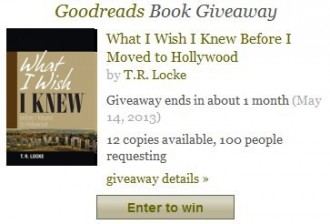
To help spur interest in the new edition’s release, I’m giving away 12 autographed copies of the 1st edition paperback in a contest on Goodreads (Click here to enter).  The contest runs through May.

If you know or care about anyone even thinking about a career in the entertainment business, no matter where they are in the process, get them this book. The title is What I Wish I Knew BEFORE I Moved to Hollywood, but the information is good for people already in Hollywood, too. What does it take to keep going?  How do you get seen? How do you get booked? How do you stand out?  What is your voice? Your niche? Your type?  And how do you stay encouraged in the hard times? Every year 111,000 move to L. A.  But every year 100,000 move away–many dejected, frustrated and sad. Those are the ones who didn’t read this book.

What’s it take to make it as a singer in Hollywood–read what Chante Moore had to say about it in my book. Trying to be comedian? Read what a standup comedian and writer for Steve Harvey, D.L. Hughley and Bernie Mac says. Want to be a producer? See what the Emmy-winning producer has to say. Want a directing/screenwriting/development deal at HBO? My interviewee had one.  Want to be an actor? Find out what a star who makes $250,000 a week says about how to become one. Want to do make-up? Find out what the head make-up artist for one of Fox’s hit dramas says you should do. Want to rap or make beats? Find out what Dr. Dre and Ice Cube’s go to guy says.

Artists love to act like they have it all together–keep a smile, be positive, stay away from negative energy. That’s all great. But are you getting where you want to go? If not, it smart to get help when you need it. It’s one thing to make others think you have it all together; it’s quite another to fool yourself.

Comments (1)

Tags: , , , , , , ,

New Free Movie Making Animation Software–Interesting

Posted on 16 February 2010 by T. R. Locke

Sarah Palin is a lightning rod of media attention. Her endurance in mass media has been amazing. When I came across this cool  new movie making animation software program by Xtranormal called Text to Movie and her pre-animated avatar, I couldn’t resist using her image to help push my book on Larry King.
Although this program is limited a bit by its computerized voice and actions, the possibilities of what can be done with it, even in its current state, are compelling.

I wrote this script, directed it and uploaded it in a matter of minutes. Getting the timing as right as possible and getting the voices to say what I wanted, took a couple hours, but viola. Moments after posting, it had garnered over a hundred views and hopefully will keep spreading.

This technology holds huge promise for writers and directors:  sharing story ideas, jokes, writing short scenes and even creating an entire web series. As the technology and text to speech capacity improves, I can imagine a lot from this program. Tell me what you think.

TRL

Comments (5)

Tags: , , , , , , , , , , , , ,

How to Get an Agent Part 2

Posted on 20 January 2010 by T. R. Locke

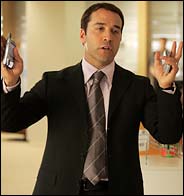
Jeremy Piven plays talent Agent Ari Gold in HBO's Entourage

Jeremy Piven plays talent Agent Ari Gold in HBO’s Entourage

In part one of this article we discussed the agent’s job as a salesman of talent and what agents need from artists in order to sell them. We discussed the Hollywood marketplace and the delicate balance of presenting yourself to an agent as both “new and original” and “like another successful artist.” And we discussed how writers can get literary agents. In this article, we will take a look at how actors, models, directors, singers and musicians can find an agent to represent them to Hollywood or New York.

The methods of finding literary agents mentioned in part one work for actors, models, directors, and singers also, but the major difference is that these artists need to produce a reel (DVD-5 minutes or less) or a demo CD of their work. A reel consists of edited clips from movies, TV shows or commercials they have filmed or appeared in; photos, performances, or songs they have written. In addition, actors also require a headshot and/or resume. Reels are the calling cards of most performance and film artists. The reel should come after you have done some good work that you believe showcases your talent well.

Once you have one, a great thing to do with your reel is to post it online. YouTube and the related online film/video sites are excellent routes to exposure. Set up your own online presence, such as a blog or website, both inside social network sites and independently and showcase your reel there also. Make sure to include a link to this site on your headshot and business cards. Some musical artist and acting/writing teams (especially comedic sketch teams) create their entire act online, gain an audience and sell their product independently. Such artists are usually in a much better position to approach agents, if agents have not already approached them, because they have demonstrated a market for their art.

Perhaps the most unappreciated bit of advice from agents is that actors and models must know their type. One great way to figure this out, if you have not already, is to watch shows to see characters you feel you relate to or could play. Ask friends and family what type of characters they see you playing and what age range they believe you could pull off. When you know your type, get your headshots made to reflect that type. When you are unified in this way, agents will know how to best market you. Furthermore, they will know that you know who you are, which suggests that others will see you clearly, too. All these unities give an agent confidence to represent you.

What does it mean to be unified in your type? An example would be the actor who knows he has performed best in dramatic roles. He may be a funny guy by nature. He may have made people laugh. But most of the praise he has received has come from dramatic roles. Furthermore, he feels more comfortable acting dramatically. The headshot and reels this actor should get should highlight those dramatic elements. His headshot should look serious and dramatic-not charming, funny, silly or cute. The clips he chooses to include in his reel should also reflect that dramatic side. By doing this, he shows the agent a clear picture of an actor who knows who he is. The agent will have no questions about where that actor fits in and when a dramatic role comes for that actor’s type, the agent will think of him.

What that actor does not want is the agent to be confused about whether the actor will work in a particular role. If one clip on the reel is funny or silly and the other dramatic, the agent will not fit the actor in either category at all. As discussed in part one of this article, think “spork.” You do not want the agent seeing you as a spork or a foon. How often do you prefer to use a spork? An artist, in order for an agent to see how to sell him, must be either a fork or a spoon. An artist who presents himself as a multi-purpose entity will only get called when a multi-purpose role is available and may even be overlooked then.

(One side note for actors-January through the end of February is pilot season in TV. Most theatrical agents are extremely busy at this time and it is not the best time for an actor to submit to them, but it is a great time to get ready to submit.)

Knowing your style, voice and genre holds true for musicians and directors, too. If you can play Country as well as Soul, pick one. Do not send your CD to an agent with both genres on it unless you do not want to hear back from her. If you decide on country, dress country in your photos, etc. It’s not hard if you think of marketing yourself to a particular audience. You can not appeal to everyone, so don’t try.

Directors have to know what stories they can tell. You must chose a genre and stick with it. Your reels must focus on the type of films you make best whether comedy, drama, action, horror; whatever you do best showcase only that one style in your reel. Make sure you clearly convey your ability to tell stories on film. And of course, if you’re a comedy director, your reel better be funny.

The best method for models to find an agent is to post your photo set online at one of the legitimate model search agencies. A little research will quickly reveal which ones are legit-the ones with proven success rates. These sites are viewed by legitimate modeling agents and usually charge a set fee to post your photos (less than $150). You only need to register with one, as the same agents look over each site. With a good set of photos (see the sites for examples) you may find your phone ringing soon.

As with literary agents, make sure to utilize the protection offered by the various guilds. Each guild (except fashion modeling, which has no guild at the present) will have a list of agents that are signed to those guilds. You can insure that the agent you submit your material to is a real agent and not someone looking to take advantage of you by submitting only to signatory agents of the various guilds: Screen Actor’s Guild (SAG), American Federation of Television and Radio Artists (AFTRA), Director’s Guild of America (DGA), Writer’s Guild of America (WGA), etc. There is a thriving business of fake agents and producers who make money taking advantage of unsuspecting aspirants. The best way to avoid these cons is to use only agents approved by the various artists’ guilds. You may also want to avoid larger agencies right off the bat. New artists can get lost in larger agencies.

Referrals can come from anywhere and are the best method of making sure your reel, headshot and resume are seen. The more work you do, the more people you will meet and the more chances you will have for getting a referral. Make sure to post your reels online and pursue as many legitimate chances to showcase your art as you can. Networking helps, but it usually requires a pretty close relationship to gain an agent referral through networking. Most people in Hollywood are barely holding on to their own agents, so you may find them reluctant to refer you unless they are not only very impressed with you, but very secure in their own career.

A good option for referrals is any casting director, producer or other person who has been impressed with your work. Mentioning to such a person that you are looking for a good agent and asking whom they would recommend could get you the name of an agent they trust. That agent is then more likely to consider you if you mention that producer’s or casting director’s high opinion of the agent. This is not considered a referral but a suggestion, yet it is legitimate, easy to get, and will likely result in the agent considering you.

Finally, entering competitions, film festivals, posting your reel and your work online and regularly submitting to agents is the day-to-day work of advancing your artistic career. Always do your art. Whatever you do, do not wait for an agent. Produce your own play, CD or short film. Many people have found their way into the business by doing so. If you do your art well and consistently, agents have a way of finding you. And remember, getting an agent is not the end of the road. Even after you land an agent, you must always work at marketing yourself, meeting new people and doing at your craft. Waiting around for your new agent to call usually results in you having a shorter career than you planned.

Update 3/7/2013: (The 2nd edition of  What I Wish I Knew Before I Moved to Hollywood available now exclusively on Kindle for only $4.99. Get yours now. Click here. Kindle e-books can be read on I-phone, I-pod, I-pad, Android, Mac and PC with the free Kindle App.)

Comments (19)

Tags: , , , , , , , , ,

I Wish I’d Written Twilight!

Posted on 19 November 2009 by T. R. Locke

new-moon-posterWell, the first show is at Midnight here in L.A. I imagine it’s opening around the country at midnight as well. That would mean that, for anyone on east coast time, it will likely open just as I’m finishing this post. Twilight has become a phenomenon.  My daughter is on “Team Jacob”—the werewolf.

No we’re not going to the opening tonight, but she did insist I drive by the theater to see her comrades camped outside. They’ve been there all day (some probably all night). They must be the first in the seats to see it. She wanted to be with them—wearing her New Moon shirt, gushing over a guy who, only a few years ago, she didn’t even notice when he was in movies. Amazing to watch as new stars are born.

I want to write something that big so bad. I want to have teens and their parents and grown people who should know better camped outside the theater talking about which is their favorite character. As one now successful actor I interviewed in What I Wish I Knew Before I Moved to Hollywood said, “I remember, years ago, I was in Gelson’s Market with only a couple bucks in my pocket when in walked this big movie star. I said to myself, ‘That’ll be me one day.’”

There’s something much deeper about this movie phenomenon we are experiencing.  Stephanie Meyer took the traditional characters of vampires and werewolves and turned them into the Capulets and the Montagues. She then took a pale, blood-sucking, night crawling, serial killer and turned him into a diamond-skinned, superhero with a powerful love Jones for the only girl in high school whose mind he can’t read.

High school? What’s Count Dracula doing in high school? Seriously, this guy is a couple hundred years old. So what if he’s young looking? What kind of perv is that? I mean, when I was 17 I thought I was too mature to date 16 year-olds. This is a guy whose obviously never heard the words to Steely Dan’s Hey Nineteen—“We got nothing in common. No we can’t talk at all.” And that guy was only 15 years older than the young girl he was considering.

But alas… love.

But since when do werewolves actually turn into giant Wolfwolves?  What is this? Do silver bullets even work anymore? Vampires have superhero powers? They can come out in the sun? They don’t drink human blood? They don’t turn into creepy bats? They can’t be killed with crosses, holy water and garlic? They don’t have fangs? What the hell? Are they trying to put Blade out of business?

I think I understand why my daughter is on Team Jacob. I think Jacob represents, for girls, the best of both worlds. On one hand, you’ve got this cute boyfriend with a great body that everyone thinks is hot. On the other, you’ve got this big shaggy dog to protect you. Girls and their fantasies.

The point of this blog is for writers and film makers. The Twilight Saga represents the best of all worlds for the Hollywood movie machine and at the same time manages to be fresh, new and young.  Vampires are among the most produced characters in Hollywood. From the dawn of moving pictures, vampires have creeped across the walls of theaters. From Nosferatu to Dracula to Blade, the basic makeup and character of vampires has remained unchanged.

What Meyer’s did so brilliantly—and if she is to be believed from her interview on Oprah, so accidentally and luckily—is figure out how to combine genres in a commercially viable way. Romance/Horror/Fantasy/Adventure.

BUT…  Good thing she wrote it as a book. If she’d pitched it as a movie or screenplay before it was a successful book, no one in Hollywood would have touched it. How do I know? Because Nosferatu came out in 1921 and no one touched it since—not successfully anyway. I should say not seriously. There may have been comedic takes on vampires or werewolves that did pretty good, but they didn’t change the nature of those archetypes.  This is a prime example of a movie that only got made because of the book.

Hollywood will happily film a successful book, video game, TV show, stage play, fairy tale or an endless number of sequels, prequels and remakes; but when it comes to putting millions of dollars into original stories movie studios, more often than not, pass.

What’s that say to you about your new, original story that no one’s ever seen before? If no one’s ever seen it before, don’t expect Hollywood to make it.

But sell it as a book first or turn it into a successful stage play, and if you’re sales figures back it up, Hollywood will come to you.

Please tell me what you think. Do you agree? Disagree? Did I miss something? I’d love to hear from you in the comments below. Thanks for reading.

Good Luck,

T.R. Locke

Comments (10)

Tags: , , , , , , , , , , ,

What to Expect at Film Festivals

Posted on 11 November 2009 by T. R. Locke

Sundance Film FestivalA short time ago, the following message was sent to me via Twitter:

“@TRLocke– Morning! I need your feedback. What are your expectations and/or objectives when attending a film festival?”

With one of the world’s top four film festival, Sundance, right around the corner (January 21-31st), I thought the answer to that question would be helpful to the readers of this blog as well.

I have to admit that my initial answer to this question was less than favorable. I’ve attended about 20 film festivals in my life—only four of them intentionally.
The first film festival I attended was as a student reporter for my high school newspaper. It was a foreign film festival in Cleveland Heights at the Cedar-Lee Arts Theater. There I saw an amazing film shot in Port-Au-Prince Haiti with English subtitles. My memory of it tells me it was similar to a French version of Slumdog Millionaire without the game show device. Despite my flattering review, I doubt seriously anyone from my high school went to see it.

The other three film festivals I attended because I had a screenplay in contention (Chicago) or because a friend had a film in contention (Hollywood), or because I’d scored free tickets to the L.A. premier of an a movie that won the prize at another bigger film festival (Los Angeles—to see Hustle and Flow with Craig Brewer, John Singleton and Stephanie Allain ).

The rest were by happenstance–usually simply the result of living or working in some artsy district like River North and Wicker Park in Chicago or The Heights in Cleveland, or Burbank (and nearby NoHo—North Hollywood) now. The scenario often plays out like this—I’m walking down the street with family or friends, only vaguely aware a film festival is running, when some young filmmaker pops out of a near-empty theater and desperately begs us to come in and watch his movie for free. We look at each other, check our watches, ask what the film’s about and how long it is and then… sometimes we go. Sometimes we don’t. Suffice it to say, not all film festivals are created equal.

Although film festivals are primarily the domain of directors and producers, there are a few objectives that can be gained by anyone looking to attend. What you can gain is related to whether you’re a film director, producer, writer or actor, etc. Either way, having a plan and reasonable expectations definitely helps.

What follows is a list of what you can expect. The information is gleaned from my own experience as well as a number of other artists and books I’ve read over the years. I’m presenting this information in no particular order.

Contacts.  Regardless of what role you play in the movie business, film festivals are a place to meet people who share your interests and professional goals. These people often show up later at different places along your career path. Networking and meeting different people may help down the line. There’s no real guarantee it will help, but I’ve never seen it hurt.  You may have the opportunity to meet and befriend someone just before their film or yours blows up. Such a person could prove invaluable to helping you in your career. It would be rare—namely because people blowing up as the result of film festivals is rare, but it could happen. Actors and writers particularly stand to gain by meeting directors and producers who may be looking to hire you. The same can be said of cameramen, cinematographers, make-up artists, etc..

Parties. If you’ve been cooped up in an editing room cutting your film for the last six months, a party could do you a lot of good. When liquor’s involved anything can happen.

Education.  There are usually a lot of great panel discussions during film festivals. You can learn new ways to finance your film, new routes to submitting your screenplays to production companies, new ways filmmakers are making money through distributing their films in various markets around the world, cheaper methods of production, new insights into the latest technologies, how the business is changing, or you may even find me there talking about some topic from my book like what to expect in trying to get your film into Hollywood, etc.. Writers can learn about trends affecting the types of screenplays that are being purchased and new avenues for writing in emerging media.  According to a friend on Facebook, Nickelodeon and other studios often present discussion panels at film festivals in hopes of finding new talent for their writing programs or even to staff their shows.

See a Few Good Movies. Though you will likely see some films that make you wonder how in the world someone would put their time and energy into making it, you will probably see a few good films as well. If you’re really lucky, you might get to see the premier of a breakout film and maybe even meet the creators before they become famous and you have to go through their assistants.

Meet an Occasional Celebrity.  Most likely the ones you may meet would be of the B, C, and D-List variety. You likely don’t know their names, but you recognize them, right?  A-Listers are usually kept in a separate room/section/party—popping out to promote their pet pro-bono project (the film that will likely go on to win the top festival award) just before it premiers. But here’s a good chance to get some pics and impress some friends back home.

For those who actually get accepted into a film festival, here are some additional ways you can benefit:

Distribution. This is the grand prize of any filmmaker attending a film festival. “The winner gets a distribution deal.” That’s why most filmmakers enter. But because it’s only a prize for the winners, it’s not really something most should necessarily expect. In fact, even winners are finding the distribution channels for independent films are bottlenecking, according to the festival director at Sundance.

Get Your Movie Seen. Exhibition is another major goal for those entering film festivals. If your film is selected to be shown at a festival, you have the opportunity to be seen by industry professionals and audiences, which could end up opening doors for you. The key here, though, is that you must know that the festival itself is not going to hype and promote your movie for you. Just because your movie is showing in a festival does not mean people will see it. You have to promote it like mad. You went through all the work to make a movie and get it accepted to a festival. Don’t drop the ball now. Finish the work of packing out the house.

Prizes. You may not win the distribution deal, but if you get any kind of recognition to your film, you could use that recognition to help drive promotion later. Any type of prize at any festival looks good on the one-sheet—even if your prize was nothing more than a new Blue-Ray player.

Publicity. Local news media is sure to cover most film festivals in some form or fashion. If your film was selected for a film fest, use that opportunity to score an interview in local press or TV that might help lead to more exposure for yourself or you film.

These are all fairly reasonable goals you can have when attending or having your film in a festival. On top of these direct benefits, sometimes being in an atmosphere with other creative people can really get your juices flowing. Maybe you’ll meet someone who will become your producing or writing partner on your next film. Or maybe you’ll make a connection with someone who has equipment or an editing suite you can use on the cheap. If nothing else, perhaps you’ll meet someone who’s going through the same struggles as you and you’ll realize you’re not as alone as you may have thought.

Most importantly though, look not only for the benefit others can be to you, look for the benefit you can be to others.

Good Luck,

T. R. Locke

Comments (15)

Tags: , , , , , , , ,

I’m a Writer– Should I Move to New York or Hollywood?

Posted on 14 October 2009 by T. R. Locke

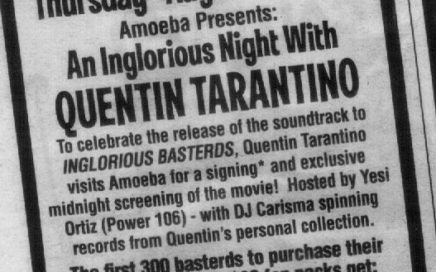
Quintin TThis is the second in a series of articles about relocating to Hollywood or New York to follow dreams in the entertainment business.

Part I—Writers.

If it’s not obvious to you, let me just state this clearly up front—this is not a question a beginning writer should be asking. In my opinion, the only people who should really be asking themselves this question are writers who’ve had some success with their craft. By “success” I mean that you’ve won awards for your screenplays or teleplays, you’ve gotten some type of representation, you’ve been optioned, you’ve produced your own plays or movies and have built an audience or you’ve placed in a film festival or writing competition. At the very least you’ve finished some writing program somewhere, have gotten feedback indicating you’ve got great talent and have written, edited and rewritten multiple screenplays. If none of these have happened, you may want to consider a move to either Hollywood or New York a bit premature—unless you’re moving here to go to school.

This section should be called Screenwriters. I called it Writers because the mass of the publishing business is based in New York. There are book writers who dream of moving to New York in the same way that Screenwriters dream of moving to Hollywood.  But unless your goal is to write for TV News or to be an editor at a publishing house, there isn’t much need for you to relocate to New York. Book writing and journalism isn’t really considered part of the entertainment world even though it most definitely is—evidenced by the lines blurring more and more every day. Nonetheless, book writing can be done from anywhere and emailed to editors and publishers around the world. If you need to take a meeting as a book writer, a teleconference or a day trip will usually suffice.

Screenwriting is a bit different.

Screenwriters’ options for if and when to move depend on whether they want to write for film or TV.

TV writers pretty much need to be local to where they work. TV writing is a collaborative effort. TV is run by writers (producers in TV are also the senior writers). The rigorous schedule of putting out weekly or daily shows requires teamwork. Teamwork requires the team be together. Different teams work different ways. Usually the writing staff meets and brainstorms the direction of the show. If the show has a strict bible (show plan or series arc) then the teams determines how far the show will move this season and may assign individual writers to write specific episodes based on the input/pitches from the whole staff. Writers may then get to work on their show for the most part, but still must participate in the rest of the show writing and development as necessary.

Most TV shows don’t have that strict a bible or are episodic. Shooting schedules demand quick writing and more minds equals more ideas faster. TV writers are salaried employees that generally work 60 hour weeks and more. On top of that, they must be there even after the scripts are written to make changes even during filming.

If a show is episodic, individual ideas for shows can be pitched and planned by the show runner. In the case of episodic shows, there is more of a chance the writer will not have to be in the room every week. The main writing staff must be present, but it is possible for episodic shows to produce a screenplay by a writer who does not live in the city. It is, however, unusual and unlikely.

Finally, if you’re writing a daily show—such as a news show or Tonight Show, etc. It would be impossible to be a regular writer without being in the room. In that case, you could live elsewhere only if you serve as a writer of a special segment.

Film writers have more options. If you chose to be a spec writer (one who writes original screenplays then offers them for sale to production companies), you can do that much the same way as novel writers. You are free to live anywhere you like and send your screenplays in to agents, managers, producers or whatever contacts you might have in the industry. No one cares if you send your script from a cabin in Vermont or from Sunset and Vine.

If, however, you desire to be hired as a screenwriter—the predominate form of film screenwriting employment—you benefit from being in Hollywood because you have to take meetings to get those jobs.  Still, before Hollywood will consider you for employment as a screenwriter on a film, you will need to have an agent. To get an agent you need a spec screenplay. And spec screenplays, as I mentioned above, can be written anywhere. So unless you’ve garnered an agent from the quality of your screenplay, and your agent is ready to get you working in TV, you do not yet need to move to Hollywood. And if you have gotten an agent and he has meetings set up for you at Warner Bros tomorrow, you might still want to fly in for a week, take a bunch of meetings and see how they go before you take the plunge. It is actually easier, in many cases, to schedule meetings if you are known to only be available for a period of time.

Here’s a final thought on this. One thing I Wish I Knew (or WIK, as I call these ideas in the book) is this: WIK #20: It may well be that what inspires you to write is native to your hometown and not to Hollywood. Do you get that?

“I moved to Hollywood from Chicago. In Chicago, the change of season, the rain, the snow, the oppressive heat, the big urban jungle, the roar of the El Train—the essence of Chicago—inspired and informed the writing that landed me an agent in Hollywood. All those inspirations disappeared when I moved to L.A. The perpetual sunshine, beautiful weather, palm trees and flowers did nothing to help me conjure up the harsh images I’d penned before. That’s another thing to keep in mind before you move. If your family gatherings or your crazy neighbor helped your pen those great stories, what happens when you’re not there anymore?”   –From What I Wish I Knew Before I Moved to Hollywood pg. 153

On the other hand, L.A. or New York can spawn new inspiration—at least that’s what the title of my book suggests. And as the photo at the top of this article confirms, there aren’t too many other places where you can watch Inglorious Basterds with Quentin Tarantino.

Good Luck

Next article will take a look at when an actor should move to Hollywood.

TRL

Update 3/7/2013: (The 2nd edition of  What I Wish I Knew Before I Moved to Hollywood available now exclusively on Kindle for only $4.99. Get yours now. Click here. Kindle e-books can be read on I-phone, I-pod, I-pad, Android, Mac and PC with the free Kindle App.)

Comments (4)

Tags: , , , , , ,

When’s a Good Time to “F” the Rules in a Screenplay?

Posted on 01 October 2009 by T. R. Locke

30inDonk

From a screenwriter in a forum:

“F The Rules…

…Is an idea swirling around in my head these days, despite being relatively new at this (I started writing a year and a half ago). I notice that people respond to my scripts when I ignore the rules (by rules, I don’t mean format), yet when I consciously employ them, I fail…miserably.

I’m beginning to think that I may be one of those guys who cannot abide by rules, at least consciously. I’m beginning to feel that, for me, they are somewhat of a creative mouse trap. Do I know them? I can’t say that I know all of them, I know that if I were to be generally interrogated (I meant questioned), that I could point to various fundamentals, but I’m beginning to feel that my brain isn’t hardwired in such a way where The Rules facilitate my best work.

So…”F’ The Rules?”

Strike you as a crazy idea? Why or why not? Anyone relate to this?

The short answer: It’s okay to “F” the rules when you no longer need anyone else to buy your script or anyone’s money to make your movie. Here’s my thoughts on this question: If you F the rules; the rules F you back. And if you’re not established yet, they F you without protection, and then discard you like a spent whore. The good thing is, you can wash up and try again.
My experience says this is not so much related to your style or skill as a writer, but to the realities of the Hollywood marketing engine. Your breaking the rules might result in a very good story, but it won’t sell. So you’ll have a great screenplay sitting on your shelf, waiting for you to get humble and change it or to finance and film it yourself.

Everything is subjective in Hollywood. No one knows what will work so everyone is paranoid. One of the only things prodcos, studios and those with the money believe they understand is rules–what a screenplay should look like, three act structure, how it should be marketed to which demographic, etc… If you want to make them more paranoid, change one of these elements. They are skiddish enough, they will be absolutely terrified if you F around with the rules.

The artist in me says, “this is bullshit! ” And it is…to the artist in me. Although, when I think about it, I’m not a fan of the avant-gard, so maybe I don’t actually like when the rules are broken either. But if all you had to impress were other writers or readers, I could at least understand it. But the name of this particular game is not “Great Stories,” it’s “Show Business.”

In tennis, they call it a low percentage shot. F the rules if you want. But do so at your own peril.

Hope this helps. Good luck.

T. R. Locke

Update 3/7/2013: (The 2nd edition of  What I Wish I Knew Before I Moved to Hollywood available now exclusively on Kindle for only $4.99. Get yours now. Click here. Kindle e-books can be read on I-phone, I-pod, I-pad, Android, Mac and PC with the free Kindle App.)

Comments (12)

Tags: , , , ,

How to Start a Script? Don’t Do What I Did!

Posted on 30 September 2009 by T. R. Locke

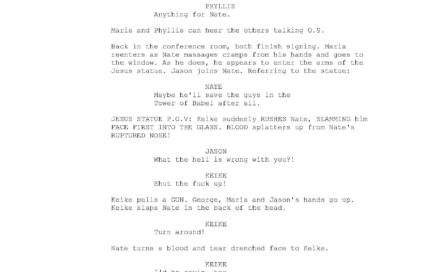
Prophets and Kings Pg 2The question that follows from a student filmmakers led me to the memory of trying to sell my first screenplay to Hollywood. What I learned from that experience was that the way you begin a screenplay can determine whether it ever finds a buyer at all. Check it out:

“Hello writers! I’m writing a crime screenplay. The plots, characters, etc. are well planned. Ready to write my screenplay after research and brainstorming, I was clueless on how to start my screenplay. A series of scenes? Montage? A simple establishing shot?

Please gimme some ideas on how to start a screenplay powerfully.”

I have some insights into what you want to do to start your screenplay towards the end of this blog, but before I tell you that, here’s what you don’t want to do:

Prior to my getting my first Literary Agent, I decided to write my film by beginning with the dramatic climax of the film–when the lead character is suddenly and viciously attacked by his friend. The scene was very violent and shocking. At the point where the lead is about to pass out (or die–part of the mystery), I used Flashback to relate how he got into that situation. It read very well. The screenplay made it through the semi-finals of the Chesterfield Film Co Writer’s Film Project and landed me a manager and attorney representation.

Agents however seemed a bit cold on the script. William Morris and CAA gave it “recommend” coverage, but passed. What was wrong?

When I landed my agent through the help of my manager, I learned what was wrong. It couldn’t be sold. What held readers’ attentions and made them cry when they read it somehow managed to disappoint different production companies for different reasons. Why?

Here’s what my agent told me:

“The film starts violently, which works for producers who want to make a violent film. But then there is no other strong violence in the film until the end. The producers who want to make a violent film would be disappointed in the lack of violence and find it too intelligent. However, those who want to make an intelligent drama would never read beyond the first violent scene.”

That revelation blew my mind. As soon as we made the change (started the movie from the beginning without using flashback), reactions grew more positive and a production company came on board.

What people don’t often tell you about films is that it’s not usually just how good the script is, but whether someone will make it. Is there a producer who wants to make that kind of film? That’s why so many scripts follow the same formulas today–because it’s not about being the coolest or the most creative, it’s about being able to sell what you’ve written. At least that’s the only way to get someone to give you money for it. It’s something I wish I knew before I moved to Hollywood. It took me years of frustration to learn. I’m not saying I agree with it. I think a lot of really good films don’t get made. But what I am saying is that it is the way it is.

So how do you start your script?

Try starting the screenplay at a point where one of two things happens–you have the inciting incident or you have the main character in his original state. In essence, start at the beginning.

Many films you’ll see will have two starts. One is meant to generate interest, then another one comes on later. Think The Matrix–the Trinity scene at the beginning piques your interest, and makes you go “wow, cool.” It starts the movie in that we learn there is something weird going on and there are people (agents) chasing a phenomenally acrobatic and armed, marshal arts, femme fatal but it’s not very clear what’s going on until much later. The other start, in some ways the real start, happens with Neo sleeping at his computer–the hero in his pre-hero world. It isn’t until much later that we learn that the Trinity scene was actually Trinity in her day-to-day world too.

Most screenplays start with either the inciting incident or the day-t0-day (and a few pull off both). Law and Order starts with the inciting incident–a dead body found at the beginning of each show. So also does Jaws (the shark attack), Jurassic Park (the finding of the mosquito in the Amber) and  The Shawshank Redemption (the wife’s murder).

Many more films start with the day-to-day, even if it’s mundane. Such a beginning can create suspense as the audience gets to know your characters while waiting to see what is going to happen to kick-start the story. If it’s the day-to-day world of a character in a comedy, it should be funny, etc. I think of “As Good as It Gets” for this kind of start. Jack Nicholson is just being himself in the beginning–stuffing a tiny dog down a trash chute because he soiled the hallway. It is his character and it adds to the plot later. Other films that start with the day-to-day? Training Day, Castaway, and Three Kings. The day-to-day should reflect the character’s life–whether it’s blah, intense, stressed, or hilarious. The best films come from character, so make sure we know your characters.

But, as important as it is for the audience to know your characters, if you want to sell a script, make sure that as the writer, you know your buyers.

I hope this saves you some frustration. It’s something I wish I knew before I moved to Hollywood.

Good luck,

TRL

Comments (0)

Tags: , ,

What Happened to the Prodco???

Posted on 26 September 2009 by T. R. Locke

waiting-prosecutedFrom a Screenwriter:

“Two production companies requested my screenplay two months ago.  I’ve heard you should give them around three months. I waited two months and then sent a follow up. “Thanks for reading any feedback would be appreciated.” This was last week. Is it usual for them not to write back at all? They asked for it and I know they got it, would they not take the time to send “not for us” email?”

—-Waiting

I saw this question on a screenwriting forum and knew there were many people who’ve had this experience and need to hear this answer.  So here it goes:

Been there many, many times. What happened to the Prodco? What’s worse is when they call you back, have you in for a meeting with the President of Production and talk about how much money they want to pay you… then disappear—never to be heard from again.

In my book,  I talk about this being a “gap event”. I describe gap events as times when you’re flying high following some great news and then suddenly experience major disappointment. See, if you’re walking down the street and you fall, that’s one thing. But if you’re flying through the air and you crash, that’s much worse. At least it feels much worse emotionally.

So to answer your question, this happens all the time. No, they won’t necessarily take the time to respond with a nice email. Why not? Well, the reasons are too many to name, but they range anywhere from they don’t like your script to the president of the company married Eddie Murphy and divorced him a few days later and is now no longer emotionally stable enough to oversee production, so everything has been put on hold. Really? Really. I wish I was joking. But that last event cancelled many deals in Hollywood—including one of my own.

Production companies are some of the flakiest companies around. They start up anytime someone decides they want to get into movies and they last as long as there’s money to keep the phones on. Anyone can call themselves a producer in Hollywood. There is no licensing, no rules, no oversight, no accountability. Even legitimate companies have many problems with seeing projects through. If your project does not become the pet project of one person whose going to champion it through the process, it will get lost. And yes, that’s even true if they loved it.

So what do you do? You recognize this is the way the game is played and you buckle down for the long run. What? You send your script out to other production companies, agents, managers, etc. You keep sending it and you keep calling and you don’t put your hopes all in any one basket—even if they have you in to their posh Hollywood office, serve you a cold glass bottle of Voss and tell you you’re a genius.  Until the contract is signed and the check is cashed keep selling your stuff.

And one other thing: don’t let this reality discourage you. It is what it is. Sometimes a better story comes along, or an important actor shows up with a different project. Anything can distract a producer—even a drug habit or his own money problems. I wish I was in your shoes. I wish I knew this before I moved to Hollywood.

Good Luck,

TRL

Comments (4)

Tags: ,

Screenwriter On Why He Won’t Read New Writer’s Scripts

Posted on 21 September 2009 by T. R. Locke

The article is important because it was written by an Oscar-nominated screenwriter, Josh Olson, and has a lot to say about different people’s  attitudes towards novices trying to break into screenwriting.

The point the author makes that sticks most with me is simply that if you’re going to ask for feedback, be ready to receive it. He argues that the careful feedback he gave wasn’t appreciated by the new writer. The writer seemed to be looking for a pat on the back or some other form of affirmation more so than true honest feedback. My first entry in this blog was called “Develop a Thick Skin.” That is true of all aspects of life in Hollywood. Hollywood judges artistic creativity on a daily basis. Whether someone is shooting holes in your perfect story, or yelling “Next” as soon as you flash your brilliant smile, rejection and criticism is part of the game.

But there’s another point the comments make that’s worth remembering as well. Josh spoke authoritatively on his own convictions about  reading screenplays. Those are his opinions. If you read the comments, you’ll notice a lot of people agree–they hate reading scripts too.  But hundreds of other writers disagree, including a number who’ve written their own blogs in response such as Franzine Kafka, and the screenwriter over at Hollywood Roaster. Once again the law of averages is in play. The simple truth is if you keep knocking on enough doors eventually one will open.  Josh may not read your script, but there are tons of producers, writers, directors and agents who will.

Comments (11)

Trujillo Review
Book Critique 1
Herman Review
Buy My Book at Amazon
Script Coverage
Buy At Barnes and Nobel
Proctor Review
Craig Review
Twitter
YourGhostwriterOnline.com
Buy at a Bookstore Near You

Twitter followers

Twitter followers

Follow T. R. on Twitter:

Follow @TRLocke on twitter.