Tag Archive | "production companies"

Tags: , , , , , , , , , ,

I’m a Writer– Should I Move to New York or Hollywood?

Posted on 14 October 2009 by TRLocke

Quintin TThis is the first in a series of articles about relocating to Hollywood or New York to follow dreams in the entertainment business.

Part I—Writers.

If it’s not obvious to you, let me just state this clearly up front—this is not a question a beginning writer should be asking. In my opinion, the only people who should really be asking themselves this question are writers who’ve had some success with their craft. By “success” I mean that you’ve won awards for your screenplays or teleplays, you’ve gotten some type of representation, you’ve been optioned, you’ve produced your own plays or movies and have built an audience or you’ve placed in a film festival or writing competition. At the very least you’ve finished some writing program somewhere, have gotten feedback indicating you’ve got great talent and have written, edited and rewritten multiple screenplays. If none of these have happened, you may want to consider a move to either Hollywood or New York a bit premature—unless you’re moving here to go to school.

This section should be called Screenwriters. I called it Writers because the mass of the publishing business is based in New York. There are book writers who dream of moving to New York in the same way that Screenwriters dream of moving to Hollywood.  But unless your goal is to write for TV News or to be an editor at a publishing house, there isn’t much need for you to relocate to New York. Book writing and journalism isn’t really considered part of the entertainment world even though it most definitely is—evidenced by the lines blurring more and more every day. Nonetheless, book writing can be done from anywhere and emailed to editors and publishers around the world. If you need to take a meeting as a book writer, a teleconference or a day trip will usually suffice.

Screenwriting is a bit different.

Screenwriters’ options for if and when to move depend on whether they want to write for film or TV.

TV writers pretty much need to be local to where they work. TV writing is a collaborative effort. TV is run by writers (producers in TV are also the senior writers). The rigorous schedule of putting out weekly or daily shows requires teamwork. Teamwork requires the team be together. Different teams work different ways. Usually the writing staff meets and brainstorms the direction of the show. If the show has a strict bible (show plan or series arc) then the teams determines how far the show will move this season and may assign individual writers to write specific episodes based on the input/pitches from the whole staff. Writers may then get to work on their show for the most part, but still must participate in the rest of the show writing and development as necessary.

Most TV shows don’t have that strict a bible or are episodic. Shooting schedules demand quick writing and more minds equals more ideas faster. TV writers are salaried employees that generally work 60 hour weeks and more. On top of that, they must be there even after the scripts are written to make changes even during filming.

If a show is episodic, individual ideas for shows can be pitched and planned by the show runner. In the case of episodic shows, there is more of a chance the writer will not have to be in the room every week. The main writing staff must be present, but it is possible for episodic shows to produce a screenplay by a writer who does not live in the city. It is, however, unusual and unlikely.

Finally, if you’re writing a daily show—such as a news show or Tonight Show, etc. It would be impossible to be a regular writer without being in the room. In that case, you could live elsewhere only if you serve as a writer of a special segment.

Film writers have more options. If you chose to be a spec writer (one who writes original screenplays, then offers them for sale to production companies), you can do that much the same way as novel writers. You are free to live anywhere you like and send your screenplays in to agents, managers, producers or whatever contacts you might have in the industry. No one cares if you send your script from a cabin in Vermont or from Sunset and Vine.

If, however, you desire to be hired as a screenwriter—the predominate form of film screenwriting employment—you benefit from being in Hollywood because you have to take meetings to get those jobs.  Still, before Hollywood will consider you for employment as a screenwriter on a film, you will need to have an agent. To get an agent you need a spec screenplay. And spec screenplays, as I mentioned above, can be written anywhere. So unless you’ve garnered an agent from the quality of your screenplay, and your agent is ready to get you working in TV, you do not yet need to move to Hollywood. And if you have gotten an agent and he has meetings set up for you at Warner Bros tomorrow, you might still want to fly in for a week, take a bunch of meetings and see how they go before you take the plunge. It is actually easier, in many cases, to schedule meetings if you are known to only be available for a period of time.

Here’s a final thought on this. One thing I Wish I Knew (or WIK, as I call these ideas in the book) is this: WIK #20: It may well be that what inspires you to write is native to your hometown and not to Hollywood. Do you get that?

I moved to Hollywood from Chicago. In Chicago, the change of season, the rain, the snow, the oppressive heat, the big urban jungle, the roar of the El Train—the essence of Chicago—inspired and informed the writing that landed me an agent in Hollywood. All those inspirations disappeared when I moved to L.A. The perpetual sunshine, beautiful weather, palm trees and flowers did nothing to help me conjure up the harsh images I’d penned before. That’s another thing to keep in mind before you move. If your family gatherings or your crazy neighbor helped your pen those great stories, what happens when you’re not there anymore?

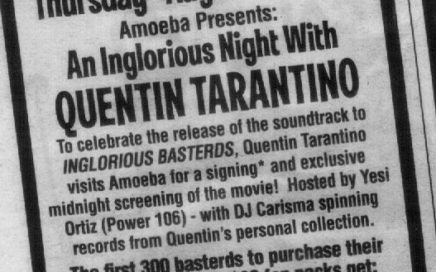
On the other hand, L.A. or New York can spawn new inspiration—at least that’s what the title of my book suggests. And as the photo at the top of this article confirms, there aren’t too many other places where you can watch Inglorious Basterds with Quentin Tarantino.

Good Luck

Next article will take a look at when an actor should move to Hollywood.

TRL

Comments (4)

Tags: , , , , , , , ,

When’s a Good Time to “F” the Rules in a Screenplay?

Posted on 01 October 2009 by TRLocke

30inDonk

From a screenwriter in a forum:

“F The Rules…

…Is an idea swirling around in my head these days, despite being relatively new at this (I started writing a year and a half ago). I notice that people respond to my scripts when I ignore the rules (by rules, I don’t mean format), yet when I consciously employ them, I fail…miserably.

I’m beginning to think that I may be one of those guys who cannot abide by rules, at least consciously. I’m beginning to feel that, for me, they are somewhat of a creative mouse trap. Do I know them? I can’t say that I know all of them, I know that if I were to be generally interrogated (I meant questioned), that I could point to various fundamentals, but I’m beginning to feel that my brain isn’t hardwired in such a way where The Rules facilitate my best work.

So…”F’ The Rules?”

Strike you as a crazy idea? Why or why not? Anyone relate to this?

The short answer: It’s okay to “F” the rules when you no longer need anyone else to buy your script or anyone’s money to make your movie. Here’s my thoughts on this question: If you F the rules; the rules F you back. And if you’re not established yet, they F you without protection, and then discard you like a spent whore. The good thing is, you can wash up and try again.

My experience says this is not so much related to your style or skill as a writer, but to the realities of the Hollywood marketing engine. Your breaking the rules might result in a very good story, but it won’t sell. So you’ll have a great screenplay sitting on your shelf, waiting for you to get humble and change it or to finance and film it yourself.

Everything is subjective in Hollywood. No one knows what will work so everyone is paranoid. One of the only things prodcos, studios and those with the money believe they understand is rules–what a screenplay should look like, three act structure, how it should be marketed to which demographic, etc… If you want to make them more paranoid, change one of these elements. They are skiddish enough, they will be absolutely terrified if you F around with the rules.

The artist in me says, “this is bullshit! ” And it is…to the artist in me. Although, when I think about it, I’m not a fan of the avant-gard, so maybe I don’t actually like when the rules are broken either. But if all you had to impress were other writers or readers, I could at least understand it. But the name of this particular game is not “Great Stories,” it’s “Show Business.”

In tennis, they call it a low percentage shot. F the rules if you want. But do so at your own peril.

Hope this helps. Good luck.

T. R. Locke

Comments (9)

Tags: , , , , ,

What Happened to the Prodco???

Posted on 26 September 2009 by TRLocke

waiting-prosecutedFrom a Screenwriter:

“Two production companies requested my screenplay two months ago.  I’ve heard you should give them around three months. I waited two months and then sent a follow up. “Thanks for reading any feedback would be appreciated.” This was last week. Is it usual for them not to write back at all? They asked for it and I know they got it, would they not take the time to send “not for us” email?”

—-Waiting

I saw this question on a screenwriting forum and knew there were many people who’ve had this experience and need to hear this answer.  So here it goes:

Been there many, many times. What happened to the Prodco? What’s worse is when they call you back, have you in for a meeting with the President of Production and talk about how much money they want to pay you… then disappear—never to be heard from again.

In my book,  I talk about this being a “gap event”. I describe gap events as times when you’re flying high following some great news and then suddenly experience major disappointment. See, if you’re walking down the street and you fall, that’s one thing. But if you’re flying through the air and you crash, that’s much worse. At least it feels much worse emotionally.

So to answer your question, this happens all the time. No, they won’t necessarily take the time to respond with a nice email. Why not? Well, the reasons are too many to name, but they range anywhere from they don’t like your script to the president of the company married Eddie Murphy and divorced him a few days later and is now no longer emotionally stable enough to oversee production, so everything has been put on hold. Really? Really. I wish I was joking. But that last event cancelled many deals in Hollywood—including one of my own.

Production companies are some of the flakiest companies around. They start up anytime someone decides they want to get into movies and they last as long as there’s money to keep the phones on. Anyone can call themselves a producer in Hollywood. There is no licensing, no rules, no oversight, no accountability. Even legitimate companies have many problems with seeing projects through. If your project does not become the pet project of one person whose going to champion it through the process, it will get lost. And yes, that’s even true if they loved it.

So what do you do? You recognize this is the way the game is played and you buckle down for the long run. What? You send your script out to other production companies, agents, managers, etc. You keep sending it and you keep calling and you don’t put your hopes all in any one basket—even if they have you in to their posh Hollywood office, serve you a cold glass bottle of Voss and tell you you’re a genius.  Until the contract is signed and the check is cashed keep selling your stuff.

And one other thing: don’t let this reality discourage you. It is what it is. Sometimes a better story comes along, or an important actor shows up with a different project. Anything can distract a producer—even a drug habit or his own money problems. I wish I was in your shoes. I wish I knew this before I moved to Hollywood.

Good Luck,

TRL

Comments (4)


 Powered by Max Banner Ads 
Advertise Here
Best Tattoo Designs
Sonic Producer
Bookstore
Learn Guitar Today
Satellite Direct TV
Advertise Here

Sponsored Links

Best Tattoo Designs
Satellite Direct TV
Arrt Photography
Twitter
Bookstore

RSSTweets @TRLocke

What's Going On Inside:

RSS Deadline Hollywood

  • 'Saturday Night Live' Comings & Goings September 7, 2010
    With Will Forte's recent announcement that he will be leaving Saturday Night Live after 8 seasons and reports that NBC's late-night sketch show may be adding as many as 4 new cast members, the question is who else might be exiting when SNL returns for a 36th season later this month. I hear Abby Elliott, daughter of Chris Elliott and the first secon […]
  • ABC News President David Westin Exits September 7, 2010
    ABC News president David Westin is stepping down at the end of the year after 13 years. The move comes after tough 12 months for Westin that included appointing new anchors on all ABC News programs and dealing with severe staff cuts. The personnel changes he oversaw included naming Diane Sawyer as the anchor of World News, George Stephanopoulos as her replac […]
  • TELLURIDE FEST CLOSES: Colin Firth Feted As 'King's Speech' Draws Oscar Buzz September 6, 2010
    Over the course of its four days, the Telluride Film Festival  has certainly become a key early player in setting at least part of  the table for Hollywood's awards season. I have seen numerous Academy voting members wandering in and out of the state-of-the-art screening venues around town getting an early look at some films certain to be contenders -- […]

Box Office Numbers

Sponsored Links