Archive | September, 2009

Tags: , , , ,

How to Start a Script? Don’t Do What I Did!

Posted on 30 September 2009 by T. R. Locke

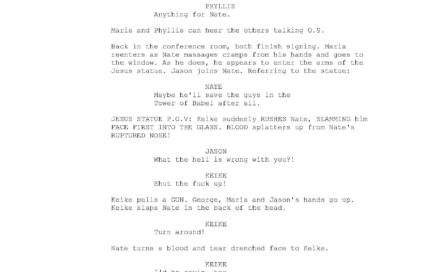
Prophets and Kings Pg 2The question that follows from a student filmmakers led me to the memory of trying to sell my first screenplay to Hollywood. What I learned from that experience was that the way you begin a screenplay can determine whether it ever finds a buyer at all. Check it out:

“Hello writers! I’m writing a crime screenplay. The plots, characters, etc. are well planned. Ready to write my screenplay after research and brainstorming, I was clueless on how to start my screenplay. A series of scenes? Montage? A simple establishing shot?

Please gimme some ideas on how to start a screenplay powerfully.”

I have some insights into what you want to do to start your screenplay towards the end of this blog, but before I tell you that, here’s what you don’t want to do:

Prior to my getting my first Literary Agent, I decided to write my film by beginning with the dramatic climax of the film–when the lead character is suddenly and viciously attacked by his friend. The scene was very violent and shocking. At the point where the lead is about to pass out (or die–part of the mystery), I used Flashback to relate how he got into that situation. It read very well. The screenplay made it through the semi-finals of the Chesterfield Film Co Writer’s Film Project and landed me a manager and attorney representation.

Agents however seemed a bit cold on the script. William Morris and CAA gave it “recommend” coverage, but passed. What was wrong?

When I landed my agent through the help of my manager, I learned what was wrong. It couldn’t be sold. What held readers’ attentions and made them cry when they read it somehow managed to disappoint different production companies for different reasons. Why?

Here’s what my agent told me:

“The film starts violently, which works for producers who want to make a violent film. But then there is no other strong violence in the film until the end. The producers who want to make a violent film would be disappointed in the lack of violence and find it too intelligent. However, those who want to make an intelligent drama would never read beyond the first violent scene.”

That revelation blew my mind. As soon as we made the change (started the movie from the beginning without using flashback), reactions grew more positive and a production company came on board.

What people don’t often tell you about films is that it’s not usually just how good the script is, but whether someone will make it. Is there a producer who wants to make that kind of film? That’s why so many scripts follow the same formulas today–because it’s not about being the coolest or the most creative, it’s about being able to sell what you’ve written. At least that’s the only way to get someone to give you money for it. It’s something I wish I knew before I moved to Hollywood. It took me years of frustration to learn. I’m not saying I agree with it. I think a lot of really good films don’t get made. But what I am saying is that it is the way it is.

So how do you start your script?

Try starting the screenplay at a point where one of two things happens–you have the inciting incident or you have the main character in his original state. In essence, start at the beginning.

Many films you’ll see will have two starts. One is meant to generate interest, then another one comes on later. Think The Matrix–the Trinity scene at the beginning piques your interest, and makes you go “wow, cool.” It starts the movie in that we learn there is something weird going on and there are people (agents) chasing a phenomenally acrobatic and armed, marshal arts, femme fatal but it’s not very clear what’s going on until much later. The other start, in some ways the real start, happens with Neo sleeping at his computer–the hero in his pre-hero world. It isn’t until much later that we learn that the Trinity scene was actually Trinity in her day-to-day world too.

Most screenplays start with either the inciting incident or the day-t0-day (and a few pull off both). Law and Order starts with the inciting incident–a dead body found at the beginning of each show. So also does Jaws (the shark attack), Jurassic Park (the finding of the mosquito in the Amber) and  The Shawshank Redemption (the wife’s murder).

Many more films start with the day-to-day, even if it’s mundane. Such a beginning can create suspense as the audience gets to know your characters while waiting to see what is going to happen to kick-start the story. If it’s the day-to-day world of a character in a comedy, it should be funny, etc. I think of “As Good as It Gets” for this kind of start. Jack Nicholson is just being himself in the beginning–stuffing a tiny dog down a trash chute because he soiled the hallway. It is his character and it adds to the plot later. Other films that start with the day-to-day? Training Day, Castaway, and Three Kings. The day-to-day should reflect the character’s life–whether it’s blah, intense, stressed, or hilarious. The best films come from character, so make sure we know your characters.

But, as important as it is for the audience to know your characters, if you want to sell a script, make sure that as the writer, you know your buyers.

I hope this saves you some frustration. It’s something I wish I knew before I moved to Hollywood.

Good luck,

TRL

Comments (0)

Tags: , ,

What Happened to the Prodco???

Posted on 26 September 2009 by T. R. Locke

waiting-prosecutedFrom a Screenwriter:

“Two production companies requested my screenplay two months ago.  I’ve heard you should give them around three months. I waited two months and then sent a follow up. “Thanks for reading any feedback would be appreciated.” This was last week. Is it usual for them not to write back at all? They asked for it and I know they got it, would they not take the time to send “not for us” email?”

—-Waiting

I saw this question on a screenwriting forum and knew there were many people who’ve had this experience and need to hear this answer.  So here it goes:

Been there many, many times. What happened to the Prodco? What’s worse is when they call you back, have you in for a meeting with the President of Production and talk about how much money they want to pay you… then disappear—never to be heard from again.

In my book,  I talk about this being a “gap event”. I describe gap events as times when you’re flying high following some great news and then suddenly experience major disappointment. See, if you’re walking down the street and you fall, that’s one thing. But if you’re flying through the air and you crash, that’s much worse. At least it feels much worse emotionally.

So to answer your question, this happens all the time. No, they won’t necessarily take the time to respond with a nice email. Why not? Well, the reasons are too many to name, but they range anywhere from they don’t like your script to the president of the company married Eddie Murphy and divorced him a few days later and is now no longer emotionally stable enough to oversee production, so everything has been put on hold. Really? Really. I wish I was joking. But that last event cancelled many deals in Hollywood—including one of my own.

Production companies are some of the flakiest companies around. They start up anytime someone decides they want to get into movies and they last as long as there’s money to keep the phones on. Anyone can call themselves a producer in Hollywood. There is no licensing, no rules, no oversight, no accountability. Even legitimate companies have many problems with seeing projects through. If your project does not become the pet project of one person whose going to champion it through the process, it will get lost. And yes, that’s even true if they loved it.

So what do you do? You recognize this is the way the game is played and you buckle down for the long run. What? You send your script out to other production companies, agents, managers, etc. You keep sending it and you keep calling and you don’t put your hopes all in any one basket—even if they have you in to their posh Hollywood office, serve you a cold glass bottle of Voss and tell you you’re a genius.  Until the contract is signed and the check is cashed keep selling your stuff.

And one other thing: don’t let this reality discourage you. It is what it is. Sometimes a better story comes along, or an important actor shows up with a different project. Anything can distract a producer—even a drug habit or his own money problems. I wish I was in your shoes. I wish I knew this before I moved to Hollywood.

Good Luck,

TRL

Comments (4)

Tags: ,

Screenwriter On Why He Won’t Read New Writer’s Scripts

Posted on 21 September 2009 by T. R. Locke

The article is important because it was written by an Oscar-nominated screenwriter, Josh Olson, and has a lot to say about different people’s  attitudes towards novices trying to break into screenwriting.

The point the author makes that sticks most with me is simply that if you’re going to ask for feedback, be ready to receive it. He argues that the careful feedback he gave wasn’t appreciated by the new writer. The writer seemed to be looking for a pat on the back or some other form of affirmation more so than true honest feedback. My first entry in this blog was called “Develop a Thick Skin.” That is true of all aspects of life in Hollywood. Hollywood judges artistic creativity on a daily basis. Whether someone is shooting holes in your perfect story, or yelling “Next” as soon as you flash your brilliant smile, rejection and criticism is part of the game.

But there’s another point the comments make that’s worth remembering as well. Josh spoke authoritatively on his own convictions about  reading screenplays. Those are his opinions. If you read the comments, you’ll notice a lot of people agree–they hate reading scripts too.  But hundreds of other writers disagree, including a number who’ve written their own blogs in response such as Franzine Kafka, and the screenwriter over at Hollywood Roaster. Once again the law of averages is in play. The simple truth is if you keep knocking on enough doors eventually one will open.  Josh may not read your script, but there are tons of producers, writers, directors and agents who will.

Comments (11)

Tags: , , ,

Sequels, Prequels and Now in 3D!

Posted on 01 September 2009 by T. R. Locke

poster-jaws-3d1 “Does that say Toy Story 2?” my daughter asked me as we passed a bus stop sign here in Burbank today.

“Yeah.”

“Oh, it’s in 3D… They already did Toy Story 2, but they’re just putting it back in theaters in 3D?”

“Yeah, that’s how they do it here.” I responded. “They resell the same movie over and over to new audiences as soon as they figure there’s a new market.”

I can’t say that I blame studios. If we’re stupid enough to go to theaters to re-view the same movie we could view at home, then they should keep releasing the same movies. Milk us for all they can get from us. Why not?

As I mention in my book, a few years ago I was in negotiations with Fox to write the sequel to the Omen. Fox wanted my take on how to keep the franchise moving along. They suggested that they wanted to begin to remarket movies they already had in their vault along the lines of what Universal had been doing with the Beethoven series. “You don’t have to buy ads for those movies. You just put it out on the shelf and it rents because everyone already knows the series. The series is the star.”

That is the highest goal of any studio—to own a series that never fails to draw an audience. Fox wanted to do that with The Omen. At the time, I hadn’t realized they’d already done four Omen movies. I was only familiar with three. At the end of the third, Damien, the Antichrist, was killed.

Apparently, Fox tried to resurrect this franchise once before. They decided a little girl would be born this time and would have the same evil in her. You didn’t see The Omen 4 because it sucked. It took me more than a week to find a video store that even carried it. By the rules in play at the time, I told the executives at Fox that the franchise was dead. That, even though Omen 4 left a definite opening for a sequel, no one would ever want to see it because the series now officially sucked. It had “jumped the Shark” as they say. The original Omen had birthed the soundtrack of operatic Latin that would go on to haunt nearly every film concerned with the devil or demons since. Omen 4 turned the greatest evil on earth into a hop-scotching joke.

So how did Fox solve this dilemma? The same way so many other studios have been quietly resolving it. They simply released the same movie they released in the seventies. Really? Yeah. Why not? The 18-34 demographic Hollywood aims at never saw the original, so all it takes is a little updating and a small budget and voila! What used to be reserved for Miracle on 34th Street every 30 years or so gets applied to everything. But now it’s no longer called “an updated classic,” it’s simply released as if it’s never been released before.

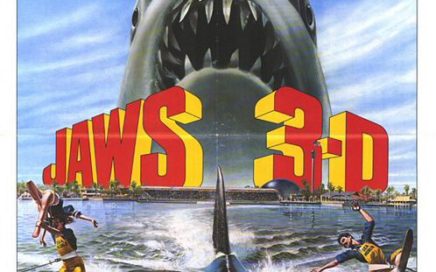
Halloween gets redone and re-released, then Halloween 2. I believe they took that franchise to seven films—ending with “Halloween H20—Twenty Years Later.” Next? Halloween 3D. It’s in the works—just like The Final Destination—the latest incarnation of that series that sits atop the weekend box-office. Toy Story 2 comes out in 3D too. I’m waiting on Jaws 3D… Oh, wait… they did that one. I guess we see where this is going. Or maybe we don’t.

How many times will people pay money to see the same film over and over again? That’s the question studios want to answer. So far it seems the answer is endless numbers of times for the right film franchise. What’s great for studios now is that it longer takes the passage of years to re-release films. It seems they can re-release them within a year or two and still draw a crowd. It is, after all, what Hollywood does—sell us what we want—or at least what we’re willing to pay for.

T.R. Locke

Comments (5)

Craig Review
Script Coverage
Book Critique 1
Trujillo Review
Proctor Review
Buy At Barnes and Nobel
Twitter
Buy at a Bookstore Near You
YourGhostwriterOnline.com
Buy My Book at Amazon
Herman Review

Twitter followers

Twitter followers

Follow T. R. on Twitter:

Follow @TRLocke on twitter.